Saturday, April 9, 2016
Personal is Political- these stories reverberate...
Stories have always had a very strong relation with me.
Books have been my best companions and since childhood, growing up in a Bengali
household, short stories have dominated my love and longing. I still remember
the magazine “Desh”, which we used to subscribe. My mother and my aunt would be
busy following up the sequence of the novels (I think those were the days of
Pratham Alo and I was in school, in
primary classes), while I used to look forward to short stories. The novelty of
idea, the fast pace and the lingering aftertaste, which baba (my father) used
to quote as “” Shesh Hoiao Hoilo na Shesh”.. always stayed with me. The short
stories written by the English writers came to me later and then too I read O
henry and Oscar Wilde. Contemporary English authors like Jack London and even
Fitzgerald, I read much later. But Bangla short stories and thereby the authors
seemed too lucrative and too loving a territory for me. We used to subscribe to
Anandomela as well, but the short stories in Desh and in the Puja Barshikis
were something I coveted for always. And
soon, Subodh Ghosh (his 3 volume short stories I still carry along with
shifting cities), Tarashankar, Bibhutibhushan and my all-time favorite Manik
Bandopadhyay came along. Travelling in
different cities, settled somewhere where access to Bangla books are less, and
of course having circle of friends from all over the country, having a spouse
who doesn’t read Bengali (I am married to a Kashmiri), made me love these
stories even more as anecdotes, I mentioned to these friends. And often
struggle to find translations. How would I ever be able to explain the
phenomenon called Parashuram to anyone, who is not oriented to the warp and
weft of the language, its wry humor?
These days, I am delighted to see so much of translation
works happening and thanks to Arunava Sinha. Half of the books by Bengali
authors that I have gifted to my non-bangla reading friends have been his
translations. Hence needless to say, the moment I saw this book published, with
an interesting title- The Greatest Bengali Stories Ever Told,
I downloaded the Kindle version and now that I am done, I want to speak of few
of the stories which have moved me completely. Not that I haven’t read them
earlier. Narendranath Mitra’s Ras I had read and so did Ashapurna Devi’s story,
still in this collection few stories just stand out for me, with multiple
possibilities..
They are:
·
Einstein and Indubala (Bibhutibhushan
Bandopadhyay)
·
Thunder and Lightning (Ashapurna Devi)
·
Ras (Narendranath Mitra)
·
News of Murder (Moti Nandy)
·
India (Ramapada Choudhury)
Of all these
stories, the first fours almost weave and complement each other, as I try to
look at them from the perspective of Personal is Political.
Well personal is
political is an essay by Carol Hanische, an interesting piece written
to analyze the feminist movements and its peripherals. Hanische through her
experiences found that often women groups were criticized of bringing the
issues of their personal life into political discourses. And the second wave of
feminism tries to argue and dismiss the concept of both being different. In fact
why more and more women were not joining the movement was because the
liminality was not clear to them and they found the movement theoretically too
conceptual to be of any use to their lives at home. Personal is indeed
political at every sphere and for the feminist movement more so, since every
single experience of oppression or love that the woman goes through is a result
of an all-encompassing patriarchal system and hence to make someone understand the
system and to defy it, be angry or have the desire to break the shackles, it’s
important to engage with her through her home and personal life and family.
Hanische said (aptly)- “One more thing: I
think we must listen to what so-called apolitical women have to say—not so we
can do a better job of organizing them but because together we are a mass
movement. I think we who work full-time in the movement tend to become very
narrow. What is happening now is that when non-movement women disagree with us,
we assume it’s because they are “apolitical,” not because there might be
something wrong with our thinking. Women have left the movement in droves. The
obvious reasons are that we are tired of being sex slaves and doing shitwork
for men whose hypocrisy is so blatant in their political stance of liberation
for everybody (else). But there is really a lot more to it than that. I can’t
quite articulate it yet. I think “apolitical” women are not in the movement for
very good reasons, and as long as we say “you have to think like us and live like
us to join the charmed circle,” we will fail.”
This has stayed with me since the time I read Hanische and
her essay and others speaking on the same area. And I now try and look into
things which speak about this strongly.
These stories to me bring back the gender lens.
Interestingly Einstein and Indubala, many may
disagree with me and I when had read it first, had typified it as a sexist
story in parts often (quite wrongly). At multiple instances the story refers to
the decision of everyone especially the males to go and see Ms. Indubala’s
performance alibi the women’s demand. This angered me, since even today such
stereotypes exist be it in office or at home. However now when I reread it and
in the light of Hanische, it seems so political to me and refreshingly so.
Einstein with all his knowledge and his idea of space can be of no interest to
women or men of a different class, the non-intellectuals, and I am not invoking
caste here. However together they all represent whom is the question and whom
do they choose? It is pertinent today especially in a majoritarian democracy
where doles and benefits seem to be a political choice of winning votes, shall
we raise our noses demeaning the choice of many (which I do often) or try and
see the political significance of the choice of others. Women find Indubala
more endearing than Einstein, someone they may not even have heard. Rightfully
so, since he doesn’t even understand them, doesn’t try to engage. In fact he
really thinks that French pamphlets will work in India? Einstein hasn’t reached
their home and their hearths. However, somehow Indubala’s presence also seem to
liberate the men from their façade, alibi accompanying the women. This story in
fact is the icing on the cake.
Ashapurna Devi, stands for her stories set in the private
spaces- home and family. She always presents a slice of intimate lives within the
4 walls of the home, the daily chores, the interplay of relations, with the woman
at the centre. In the introduction to Prasenjit Gupta’s collection of Ashapurna
Devi’s short stories Jhumpa Lahiri mentions: “The home itself, as both physical setting and symbolic space, is the
most central feature of Ashapurna Debi’s stories, and it frequently plays a
complex and contradictory role. At times the home represents an adversary, a
physical prison, a site of constraint beyond which the truth about a family
cannot be disclosed. At other times her stories endorse the home as a haven, a
refuge representative of ownership, comfort, and escape, which protects the
individual from the danger and disorder rampant in city life. This polarized
notion of home, as both prison and sanctuary, provides perpetual grist for
Debi’s fictional mill”.
Thunder and Lightning is no exception. However here the
protagonist Bula almost poses a very political question through living her
personal life and her choice of financial access. Bula, the rejected wife and the
ever-servile daughter-in-law leaves her in-laws house to join films. The family
disowns her, however is seen at an interesting quagmire when she sends money
order. And this also exposes the biggest question- is financial independence
the way to woman’s liberation, so called economic empowerment, or its merely a negotiation
tool, softly buying and bribing existence- since the so called inherent right
to dignity is not there. Also for Bula, home and her access to family become
symbolic of her existence-the lines between oppressors and the oppressed
becomes blurred here.
Ras by Narendranath Mitra
again brings forth this question of economics in marriage or family. This translation
was published earlier in Caravan (http://www.caravanmagazine.in/fiction-poetry/ras)
However in this rural economic setting there is more to the story that mere economics
and games around it. This is equally the story of two distinct women- Majubi
and Phulbano, women who were open and unabashed about their choices and their
desires. That is incredible. Phulbano seeks divorce from her first marriage due
to her dissatisfaction with an older husband and Majubi, being divorced by
Motalef, is clear about her options. The interesting part of the story is, one
cannot distinctly side with anyone. At one point I may hate Motalef with his
schemes and transactions, however did Majubi doesn’t appear to be a victim.
This interplay is what made Ras remarkable to me.
News of Murder by Moti Nandy
reminds me of an essay I read sometime back about the anxiety that all women go
through in fear of violence of any form. It said that the fear of rape
permeates our lives. And the social
stigma associated with it. The cage seems to suffocate the living. Bibha’s
paranoia was brought upon by her family and its confines. A small news on the newspaper,
having the name of the victim same as he name, got the family fussing over her
apparent security and more of saving their honor at the cost of her impending
confinement. Something I think women go through at every point in their lives.
India by Ramapada Choudhury
of course needs to be looked with a different lens. The last few lines, is still
going through my mind- “The train left. But everyone at
Mahatogaon turned into beggars. All those people who lived off the soil- all of
them had been turned into beggars”. Isn’t this something too well known to all of
us- we may not even need the Americans throwing off coins as amusements. There
are structured organizations to do the same, banks, UN agencies with doles and
schemes, with good intentions of helping communities. This reminded me of Damisa
Moyo, the African author and economist who writes critically of the aid
culture, ripping communities of their rights and dignities in the pretext of
help. This is indeed a very interesting piece
and I am planning to use this as a story for discourses on development,
sometime in a group.
However, it’s a very interesting collection
and of course contributed to making my Saturday a great one.
Skills for Life--Dilemma, conflict, truth, humanity…Children’s books tugging at the strings of your heart
Skills for Life--Dilemma, conflict, truth, humanity…Children’s books
tugging at the strings of your heart
Moral Science can often be a boring lesson at school, unless few
teachers wanted to make it interesting, by bringing stories and the questions
associated with them- what do we think right or wrong? Suddenly as a 9 or 10
year old, to be asked about our thoughts and decisions used to be a big deal,
engaging us in discussing with each other, falling upon our limited experiences
but with clairvoyance and of course giving us the agency. Stories did that very
well. Suddenly putting yourself into the shoes of those characters and trying
to think as you would in those space and time, made me imaginative and of
course my ever-lasting love with stories was inevitable. I remember once when
we were discussing one particular story Elves and the Shoemaker, especially
when the happy shoe-maker loses his peace when he was no longer needed to toil
hard for a leaving. At the age of 8 or 9, I really could not understand why
would one lose his peace when he gets all he wanted and still wanted to work
hard. What was it that was missing and so dear to the shoemaker even amidst his
penury. Those were the years of innocence and tinted glass, where you want to
wipe out sorrows and pain from everyone and you look at poverty only through the
angle of a single story- the story of deprivation and oppression, and not the
story of inherent human dignity. Even now, elves and the shoe-maker intrigue me
a lot, especially now when I somewhat know the development sector and the fund
dependencies as an adult.
However how do to bring curiosity and question to the young minds. To
not give them answers and make them imaginative thinkers. Especially when it
comes to intrigues like right or wrong- not to make them followers but seekers.
And isn’t seeking a skill for life?
I always look for books which bring forth such dilemma, especially
when it comes to children and I have a few to speak of.
Satyadas by Bimal Kar – adapted by Katha with beautiful illustrations.
Stayadas doesn’t tell clearly about a moral practice but poses a
question. Its about Raghunath, running a small grocery store in a small colliery
town of Bengal. He struggles to make ends meet, however is not bereft of
empathy towards fellow human beings. This inherent sense of human connect
prompts him to give shelter to Satyadas, a stranger peddler on a rain soaked
evening. Satyadas goes away next day, but leaves back some gold coins and thus
his part magic presence becomes temptation to Raghunath. Raghunath waits for
Satyadas to be back for days and then in utter need, he falls back on these
jewels. The stones symbolise the eternal clash between good and evil, while the
six gold coins embody the six seasons. A year later, and after Raghunath has
spent the gold coins, Satyadas returns. This time he is an embodiment of
conscience. For when he goes away, he leaves behind a guilt-ridden Raghunath.
The author portrays Raghunath’s inner conflict skilfully as he battles with the
demons inside him and debates the rightness or otherwise of having taken
someone else’s money. However indeed we may side with Satyadas and understand
Raghunath’s act as that of treachery, dishonest. However, was Satyadas for
real, never claiming his possessions and what would one in the place of
Raghunath do, when it comes to the question of survival or keeping up with the times?
Even for an adult with absolute stand and clarity between right and wrong,
black and white the book with lovely charcoal illustrations give a sense of
grey. Would be interesting to know how a young reader will think about this.
Pinti Ka Saboon:
Pinti Ka Saboon is another interesting story based now in Kumaon, in a
small hamlet at the foothills of the Himalayas. The little hamlet was indeed
aware of fragrant soap- they had seen Pinti, the once stationed army officer’s
daughter using it and leaving a trail of fragrance behind. But none in the
village ever possessed one, till Hariya won a nicely packed and wrapped piece
of pink soap. Possessing something which none had, gave him a sense of power
and alienation. The relations coveted to him now seemed to him as a threat, who
would try and dispossess him of his new-found treasure. This engulfed him. The
simple Himalayan foothill village suddenly becomes a place of conspiracy,
threat and enmity for him. And it also brings in a cloud of unrest amongst
others in the family and village. Something they were happily unaware of in
their equal status quo of not having. A very interesting story, for all. And for
children, for all that we often covet, it’s a cue to make us think, all that we
want, are we ready to share it with everyone?
Curfew
Curfew again is a story of inherent human bonding. Posted in the
conflict ridden city of Shrinagar, soldiers in charge of curfew, suddenly find
themselves in an awkward position. They become one and all with the citizen’s
struggle to carry on with life, with the natural ebb and flow, sometimes
picking up ball for a crying infant or passing food from one house to the other
across the street. They find themselves torn at the inner war within them to
listen to the call of life and its demand, or to bring in the iron hand, alibi
ensure peace and security. This is
something which should be introduced to young people, to make them understand
the multiple possibilities, the existence of multiple stories..
Ek Anmol Sathi ke Liye
Ek Amnol Saathi ke liye is more about moral courage and taking a stand.
A young impoverished painter gets a commissioned work- his make or break in
life, to pain Buddha, with all animals in the universe barring cats. The guy
however had a pet cat and had a unique relation with the little cat, who was
his only friend. In the eyes of his little friend, he saw the desire to be
included into the canvas and he decided to go ahead, to place the little cat
with the all forgiving Lord. Once discovered, the monks were furious. However
once the portrait was revealed, it showed Buddha placing the cat on his lap,
showing the universe has a place for all. It’s a beautiful story by Rosalind
Wilson adapted by Katha.
Aapni Aapni Pasand
Vijay Dan Detha’s story are part magic, part folklore. Katha’s
adaptation of the story through beautiful illustration is interesting yet
thought provoking. As an adult there are different angles to look at the story.
The story is about two women a florist cum gardener and a fisherwoman. One fine
day they meet and decide to swap their places. For few days they remain happy,
till they start missing their old professions, the smell of fish, the scent of
flowers. If I want to look at it from an angle of caste and class, this will be
a little unacceptable for me, where somehow the story ends with both going back
to their old states-However there can also be a more philosophical way of
looking into this, related to the core belief or value of one self. Would be
great to know how children will look and think of this.
Fledolin
Fledolin is the story of the little bat who almost embarrasses his
community by defying what is considered normal or natural. He doesn’t enjoy
hanging upside down. The illustrations are immensely engaging where it is seen
everything upside down is normal and Fledolin on the other side. The parents
and other bats are wary of his future, till the local yo-yo competition comes,
where Fledolin’s deftness to deal with gravity helps him to win. This is
interesting to raise self-esteem and also to question what is normal finally.
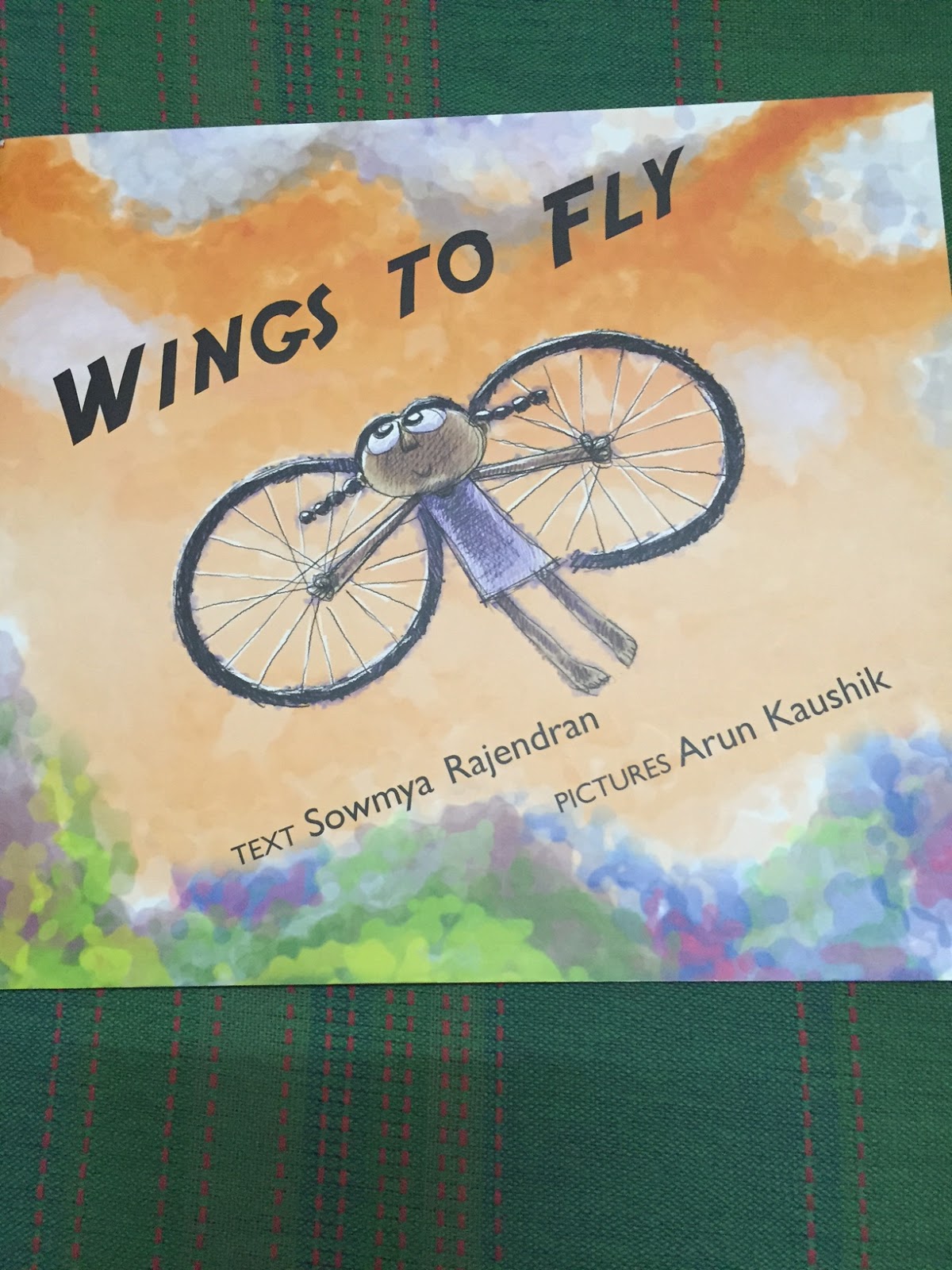
Wings to Fly:
This is a beautiful book of little Malathy, pinned to the wheel-chair,
but wit hopes to win competitions though running. This is in fact the story of the
remarkable disabled athlete Malathy Holla.
These books give the scope to imagine, think, and question. Why a bat should
not hung upside down, will also give the trust to hope that a girl in he
wheel-chair can win races, its possible. Multiple possibilities and stories
exist. Soldiers not only kill but are also human beings, and Kashmir is not a
place of militants but also of children who want to play in the streets. Its
fine to win gifts and ask for more, but like Pinti, will more not make way for
having less love within me for all around me. Also shall we not listen to the voice
within our hearts, our authentic voice, since right or wrong as Satyadas said, “
you know within yourself”… and hence reading these books can also be a journey
of seeking….
Sunday, April 3, 2016
Mitro Marjani...Of Desire and Longing..
As women are we supposed to have desires? Carnal? And if so, how do we express and long for it.
Krishna Sobti in her 1964 book Mitro Marjani created Mitro aka Sumitravanta,
the wife of the middle son of a mercantile joint family as if to speak it out..
so out of her times and ways.
Mitro is unabashed about her desires and longings. She feels
that her body, her beauty has more to it that merely be an obedient house-wife
and suppressing wishes. Hence she engages in verbal as well as physical battles
with her husband. She is an odd-one out. However the interesting part is the family
which although wary and repulsive accepts her frankness. Mitro speaks about sex
openly and in fact gets angry at the hypocrisy of keeping things under the wraps. In fact this is her power, which makes her
husband lash at her, her in-laws to keep a distance away from her.
And I wonder what make Sobti write about Mitro. Mitro also
has a mother who is open about her desires, to the extent, she being a widow is
almost jealous of her daughter and her proximity to her husband. Where have we
seen such female protagonists- so full of desire? In fact in many novels of those
times and even now, we find the protagonists repentant and almost to do penance
for this kind of carnal longing or even longing for an identity. This reminds
me of Grihadaha (by Saratchandra) and in fact even in Tagore’s novels, the one
who desires, is almost plotted as the one who creates anarchy and even Tagore couldn’t
handle anarchy….
Wish there were more Mitros and that would have changed the
dialogues and discussions in a household..
Saturday, April 2, 2016
Magic, Madness, Colors and Eternal Strengths of Humanity
Growing Up in Pandupur (Aditi and Chatura Rao)
Amie and the Chawl of Color (Chatura Rao)
The Burmese Box (Lila Majumdar)
The Yellow Bird (Lila Majumdar)
Eid stories
These are books for children and there are books for all. For me, these 5 books are for all ages, some recreating nostalgia and magic and others reminding us the eternal strengths of love and humanity.
Growing Up in Pandupur is an interesting work. Apparently seen as a collection of 13 stories are linked to each other. Its about a township growing up along the banks of the Dhun river and the river has its own song saying..
"..Of humans who came and cleared and farmed...
home to the native farmer...
then came the traders beady eyed man, to sell the farms,...
The Government said to build a dam...
.... and
with engineers came their families..."
This is the story of any township in India, growing and accomodating more and more people whereas the natives, the forests keep on getting pushed outside. Pandupur has railway station, schools, but then there are different kind of schools right?- One where the engineers will send their kids and another where the natives (read tribals) will send their children. One interesting story is warm and fuzzy which speaks about this. This is indeed a warm collection, which may make us ponder over our ideas of growth and development even through stories of a fictitious township.
Amie and the Chawl of color is almost like Dorothy and the wizard of oz, however here it is metaphorical. we know Amie too well and her chawl as well in the city named here Doombay(we know what in real the city is called right!!) Now suddenly Amie's chawl and particularly Amir faces a great crisis. The little bit of sun that managed to creep inside Amie's small pigeon hole of a room, faces threat from entering.due to the billboard set up and the prospects of many such billboards blocking and taking the hues out of their lives. (can we remember what is happening to the Mumbai chawls, the threat from builders..) Amie loves her mother and also the others in the chawl, the microcosm of the cosmopolitan Doombay and takes things to her hands to meet Shah of Vibgyor bring colors back.. part adventure and part magical.. this is a beautiful book.
The Burmese Box and The Yellow Bird.. by Lila Majumdar are lovely reads (the original read by me much earlier in Bangla) The gifted storyteller that she was.. Lila Majumdar has deftly woven treasure chests and detective stories with magic realism. The Scheming Podi-pishi dies lamenting for her lost jewellery box and then adventures cloud up around the box. Whereas Jhogru mixes imagination and myth into the yellow bird to attain the impossible.
Eid stories are my all time favorite. This is a collection of stories circling round the festival of Eid. Paro Anand's story speaks about taking a stand against bullying and weaving integrity and inclusivity in schools. My favorite is Sweets for Shankar by Aditi Rao- taking cues from an incident where a young Muslim boy met Gandhiji during his rounds of appeal for communal harmony to stop riots post partition. This young Muslim boy, puts his life on threat to pass on sweets for Eid as promised to his friend Shankar, something the poet fictitiously created as if was a re-assurance to the Father of the Nation to have faith in Humanity in those dark days of madness.
Highly recommended for all to read..
Amie and the Chawl of Color (Chatura Rao)
The Burmese Box (Lila Majumdar)
The Yellow Bird (Lila Majumdar)
Eid stories
These are books for children and there are books for all. For me, these 5 books are for all ages, some recreating nostalgia and magic and others reminding us the eternal strengths of love and humanity.
Growing Up in Pandupur is an interesting work. Apparently seen as a collection of 13 stories are linked to each other. Its about a township growing up along the banks of the Dhun river and the river has its own song saying..
"..Of humans who came and cleared and farmed...
home to the native farmer...
then came the traders beady eyed man, to sell the farms,...
The Government said to build a dam...
.... and
with engineers came their families..."
This is the story of any township in India, growing and accomodating more and more people whereas the natives, the forests keep on getting pushed outside. Pandupur has railway station, schools, but then there are different kind of schools right?- One where the engineers will send their kids and another where the natives (read tribals) will send their children. One interesting story is warm and fuzzy which speaks about this. This is indeed a warm collection, which may make us ponder over our ideas of growth and development even through stories of a fictitious township.
Amie and the Chawl of color is almost like Dorothy and the wizard of oz, however here it is metaphorical. we know Amie too well and her chawl as well in the city named here Doombay(we know what in real the city is called right!!) Now suddenly Amie's chawl and particularly Amir faces a great crisis. The little bit of sun that managed to creep inside Amie's small pigeon hole of a room, faces threat from entering.due to the billboard set up and the prospects of many such billboards blocking and taking the hues out of their lives. (can we remember what is happening to the Mumbai chawls, the threat from builders..) Amie loves her mother and also the others in the chawl, the microcosm of the cosmopolitan Doombay and takes things to her hands to meet Shah of Vibgyor bring colors back.. part adventure and part magical.. this is a beautiful book.
The Burmese Box and The Yellow Bird.. by Lila Majumdar are lovely reads (the original read by me much earlier in Bangla) The gifted storyteller that she was.. Lila Majumdar has deftly woven treasure chests and detective stories with magic realism. The Scheming Podi-pishi dies lamenting for her lost jewellery box and then adventures cloud up around the box. Whereas Jhogru mixes imagination and myth into the yellow bird to attain the impossible.
Eid stories are my all time favorite. This is a collection of stories circling round the festival of Eid. Paro Anand's story speaks about taking a stand against bullying and weaving integrity and inclusivity in schools. My favorite is Sweets for Shankar by Aditi Rao- taking cues from an incident where a young Muslim boy met Gandhiji during his rounds of appeal for communal harmony to stop riots post partition. This young Muslim boy, puts his life on threat to pass on sweets for Eid as promised to his friend Shankar, something the poet fictitiously created as if was a re-assurance to the Father of the Nation to have faith in Humanity in those dark days of madness.
Highly recommended for all to read..
Thursday, March 31, 2016
Death of Professions or Saga of Subaltern
Review_ The Lost Generation- Chronicling India’s Dying Professions by Nidhi Dugar Kundalia
India currently is proud of its demographic dividend and is
keen on leveraging of this. Hence an estimated 550 million people need to be
trained in skills, so that they can get employed thereby changing their fate as
well as contributing to the GDP of the country. Interestingly almost 80% of
these trades belong to the informal sector with no regulations, minimum wages policy,
hostile working conditions. And in addition there are hundreds and thousands of
people who are earning their livelihood, without any recognition of the means
as a trade. These are the questions which I often struggle with. A young boy
from Tejpur, comes all the way to Delhi to work in a shopping mall, earning
8000/- per month and sharing his accommodation with 7 others in a pigeon hole
is supposed to do meaningful contribution to the economy, whereas in his
village a vegetable seller who pushes his cart ful of greens to the local
market doesn’t.
Interestingly the one who sells his own veggies and may even
produce them has the capacity to think, create a livelihood option with this
hands and is independent to some extent, still reeling under the burden of
financial insecurity- being an entrepreneur. And the ones, who migrates, to
work under someone is the one who contributes. However what will happen if
suppose the Mc Donalds in Haryana, where this guy is working gets gutted down.
What about his profession? He is employed under someone and what about social
security etc. How as a country we look at jobs and not at entrepreneurship and
in fact let many of the professions die. Many however cannot cope up with the changing
demands of time. What are the fates of professions, if winds of time render
them useless. What happens to that community? Or it is again the saga of the sub-altern?
The one who had no voice and even the profession was not a choice or “ freedom
as development”. They fell into accepting those, or compelled to do so, unable
to get rid of the class, caste, gender baggage.
The Book- The Lost Generation- Chronicling India’s Dying
Professions by Nidhi Dugar Kundalia, exposes us to a magical journey of 11 such
professions, many should have been obliterated long back for its sheer
oppression with respect to gender and class.
Nidhi takes us to Jharkhand to view the Godna Artists doing
tattoo on forehead of little girls to the Rudaali women in feudal Rajasthan
village. There the women from upper
caste cannot try or show emotional exuberance or vulnerability in front of
others- repression works even to prevent them fropm expressing sorrows and the
Rudaali women are the surrogate sorrow- bearers, emptying their soles and their
eyes. At Haridwar the genealogists, seem to exude a feeling- how deep rooted
caste sits in our system. The Kabootarbaz in Delhi refuse to accept their
profession as an abuse to animal rights- however oblivious of the fact that the
entire scheme was the fancy or whim of some rich nawab once upon a time. At
Vikarabad in Andhra, we meet the Burrakatha story-teller, the part of the
Jangam tribe, considered untouchables, and whose next generation has no problem
in accepting a stable government job as a garbage cleaner with the municipality.
At Baroda, the street dentist questions the relevance of medical schools, if
the poor cannot afford the fruits of such education and he is proud of his own
skills. The Urdu Scribes in Delhi are fighting not only the technology which
has now given way to fonts, but also the idea of “ nationalism and other” which
is hastening the decay of Urdu language. The Boat makers of Balagarh depict how
culture and politics can go hand in hand- when the boats are used across the
river for election propaganda and then re-used for immersion during Durga Puja.
The Ittar Wallahs of Hyderabad, fondly reminisces his skill of creating the
aroma for the “rooh” and seems to feel proud at his skill of identifying
fragrances of the rich and poor, through some uncanny logic. The Bhishti Wallahs
of Kolkata, now rendered of no use, are struggling with poverty, unable to get the
OBC certificate and clutching on to the nostalgia of old camel skin “ bhishtis”-
the word originating from the Persian word “ Beheshth” or paradise. (indeed
water meant paradise in the deserts and the battlefields, where these water
carriers or Bhishtiwallahs use to quench the thirst of the wary).
The most interesting one was the letter writer in Mumbai.
Coming from Benares, he had made his living with honor, dominating the script
of the ones who had none. However 2002 onwards, computers and email and mobile phone has now posed a
threat to this very profession. His deftness to express in form of the letter,
is now not needed.
Throughout the book, however I could also see class playing
a large role in the professions. Those who belonged to the upper caste
dominated the “script”, be it through genealogists in Haridwar or the Letter
Writer from Benares or the Urdu Scribe, who takes pride in curating books for
Kashmir schools. Whereas the rest, once the subaltern in colonial domain, still
reel from the pressure of caste or marginalization. Which makes me question- “has
the saga of sub-altern really changed?”. Indeed the story-teller of the Jangam
tribe in Andhra will become a garbage cleaner while son of the letter writer
will join marcom industry and that of the genealogist in Haridwar has joined IT
industry.
And when we charted the course of skilling, to employ 550 million people, we have also done the same, hardly giving them a freedom of choice, we know who will become a construction worker toiling in the concretes and living in a shanty and who will become the software engineer.
This is an interesting book- and after reading this wonder
when would we realize that all professions will die, unless we have the power
to create and choose one that befits us and our thoughts and wishes?..
Labels:
Bhishtis,
caste,
dying professions,
employability,
ittarwallahs,
skills
Jai Bheem- the history denied (often)
Reading about Ambedkar- (for children and adults alike)
Bhimayana and The Boy who asked Why...
Quoting Paulo Friere-“… Without a sense of identity,
there can be no real struggle…”. Looking at the case of HCU often I question
that how can a sense of identity be
crated if there is a systemic approach of denying history. How much do we know
of the Caste Struggle and the man who brought the same to the fore-front.
Few years back, a young girl, interning with me had visited
one of the Mumbai slums and had come back dazed at the resilience of the people
staying there battling deprivation. I was angry indeed. I could not understand
what surprised her and pleased her so much, deprivation or the battle to
constantly decry the same and got engaged into a discussion with her. At one
point she was vociferous of the talent and turn-around of few children she met
there through education and found that heartening and that enraged me
more, and I started questioning her
about meritocracy. What did she mean, when she said that everyone can make it
big, given the right opportunities? Where does opportunity begin? And this
immediately brought the question of caste and affirmative action. And of course
the man behind it. Of course she was young with tinted glass to look at the world,
however to my dismay I found had no sense of identity and backgrounds of
community and hence a limited view of their struggle. And above all, an
absolute absence of historical concept. She actually didn’t know much about
Ambedkar.
This made me look back into the history syllabus in school
till 10th across all boards. And to my dismay I found that there is
an emphasis of India’s freedom struggle, Medieval as well as Ancient India, but
hardly any mention of the Caste struggle, the India against Indians and of
course only a fleeting mention of Dr. Ambedkar as the man who wrote the constitution.
At that time, started looking at books for children which
speak about Babasaheb. And found only an ill-represented Amar Chitra Katha
version- an absolute water-shed on the political understanding of the man.
Its only recently a couple of years back that I discovered Bhimayana-
by Navayana. A beautiful graphic biography helmed as one of the top 5 political
comic books (the genre is a bit problematic though)
The graphic visuals has been done by Durgabai and Subhash
Vyam and depicts the Gind art form of tribal Madhya Pradesh. The uniqueness of
the book is its political frankness and the debate presented be it against the Manusmriti
or the Mahad Satyagraha- all in form of Gond art form- its truly remarkable.
Kudos goes to the team to create tension through art form throughout,
poignantly representing the caste struggle.
This book is indeed a must read- to know the history creatively
and in an engaging way. Interestingly it has been translated into Several
Indian languages and international languages- French and Korean.
However, For young children, how does one introduce Ambedkar
and his political discourse and stand- against discrepancy and call for
equality and dignity for all- the fundamental of all human rights. Thanks to Tulika for coming up with The Boy who Asked Why.
For young children, I cannot think of any other interesting method
to introduce a political understanding of caste. The illustrations by Satwik
Gade is engaging and that’s what makes the book enticing for young audience.
What comes across in the book is the inherent curiosity of any child to
question WHY? This is the root of all
learning and struggle. WHY propels us to know more, to explore and that’s what
Bheem did.. ask the right questions
about the inherent right to human dignity. How can amongst same human
beings, one can be more equal than other to the extent of being oppressive. The
courage, the sharpness of this character gets captured beautifully in the illustrations.
The lawmaker believed in law, to be the chance to give
everyone an equal chance in life. The
current situation of the country however can challenge that shining hope. However for the young citizen of the country curiosity
and hope and a vision to look around and still trace inequality (to later have
a voice to challenge that) is much needed. These two books can at least be the
beginning of their political understanding. And if parents are concerned about the
words politics- then they must not, “ There is politics is everything… even personal
is political”
Clumsy… and so is the Rainbow with a dash and splash of colors…
Clumsy… and so is the Rainbow with a dash and splash of
colors…
Can’t you not draw your crayons inside the marking line? How
clumsy you are? The teacher did not even leave at that. While coming home, the
mother was reminded of the often graze of the child to uncharted territories- coloring the dog as pink, straying out of the dark thick black lines and
spilling colors all over the page. This must be our story or someone we know
too well. There is an invisible code everywhere, where and how things should be
kept, how coloring should be done, how books should be piled, how a dog should
look.. all packed into boxes… and if you stray out- you are clumsy, sloppy,
careless, slowcoach… In fact the school books turn crimson with angry comments
as if the pages shrink in shyness embarrassed at the remarks.
This was happening to the little girl in the book by Ken
Spillman viz. Clumsy. A book which peers deep into our souls, pulling out those
memories where we were forced to wear straightjackets and remain within the
boundaries. What happens to those, who hum a different tune and rhythm, are
they to be discarded? To be called clumsy.. what about their names? Who created
the rules and benchmarks for the toothpaste to remain within the cap and the
shoelaces to be tied neatly.
Manjari Chakravarti’s illustrations make the story real, you
almost feel one with the little girl and her heartbreaks, her shrinking self
esteem, till she discovers her rainbow.. the colors which through the messy
hands become someone who is not clumsy, who has a name..
The colors danced around her
And she wanted to dance with them…
She painted all her stories,
And she wrote her name in the corner
It was the name her parents had given,
A name that many seemed to have forgotten..
And it wasn’t Clumsy, Slowcoach, Careless,
Sloppy, Messy, Butterfingers…
This is a
lovely book for all of us, parents, children, adults, who want create rules and
then forget the people behind. Everything becomes the rule for us and one
straying away is then typified as clumsy……..
Every child
and every one is special.. its just that we have to help them find and paint their
own rainbows… the world is beautiful as long as it is colored…
Subscribe to:
Posts (Atom)